
Authored by Daphne Naudho, Action for Liberty and Economic Development, Joyce Mary Takali, Malkia Africa Network

Executive Summary
● The Problem: Women comprise the vast majority of Uganda’s informal urban economy, particularly
in small-scale retail and street vending. Current trade order enforcement mechanisms, characterized
by abrupt evictions, asset confiscations, and rigid zoning regulations, disproportionately undermine
women’s financial survival, disrupt household welfare, and deepen economic vulnerability.
● Core Finding: Punitive enforcement practices treat informality purely as a public order issue rather
than an economic reality. Because women systematically balance trade with heavy caregiving
responsibilities and face steep structural barriers to formalization (such as high compliance costs and
inaccessible formal commercial real estate), spatial displacement effectively strips them of their
primary sources of income.
● Top 4 Policy Actions: Mandate Gender-Responsive Operational Guidance; map underutilized
municipal land to deploy low-cost, modular trading kiosks; establish institutionalized Trader
Representation Mechanisms requiring a minimum 40% female composition; and launch
Incentive-Based Formalization Paths featuring “starter licenses” bundled with business support
vouchers.
● Expected Outcomes: Stabilization of low-income household consumption, minimized livelihood
displacement, increased voluntary transition into the formal tax base, and enhanced public order
achieved through cooperation rather than coercion.
- Introduction
Uganda’s informal economy is a principal engine of macroeconomic survival, employing approximately
89.2% of the national workforce (UBOS, 2025). Within this landscape, informal retail, street vending, and
open-air market trading serve as the primary entry points for women seeking economic
self-determination. For these micro-entrepreneurs, barriers to formal sector entry—including prohibitive
capital requirements, complex bureaucratic licensing, and systemic gender disparities in land
ownership—remain restrictively high.
Concurrently, urban authorities face escalating systemic pressures. Rapid urbanization has intensified
challenges related to public space congestion, municipal sanitation, pedestrian safety, and lost tax
revenue from unregulated commercial activities. In response, local governments have intensified “trade
order enforcement” campaigns to clear public thoroughfares and channel commercial actors into
gazetted municipal markets.
The central policy friction is that maintaining urban order using current punitive models creates severe,
unintended economic shocks for women traders. When a roadside vendor’s inventory is confiscated or
her point of sale is summarily eliminated, the financial shock propagates instantly to her dependents.
This brief provides a framework to transition Uganda’s urban management from a model of punitive
clearance to one of incentivized, gender-responsive integration.
- Research Overview and Context
A. Institutional Framework of Trade Order Enforcement
Trade order enforcement encompasses the regulatory and physical measures deployed by state actors to
govern commercial space usage. Currently, enforcement centers on clearing vendors from pavements,
road reserves, drainage channels, and non-gazetted open areas.
While statutory mandates charge these authorities with maintaining public safety and zoning
compliance, parliamentary debates and civil society evaluations show that current execution patterns
lack standardized, socio-economic risk screening. Guideline execution falls heavily on local governments
and municipal bodies under national guidance from the line ministries.
B. The Dynamics of Gendered Informality
Data from the Uganda Bureau of Statistics (UBOS) 2025 Labour Market Survey highlights the structural
reality of the Ugandan workforce:
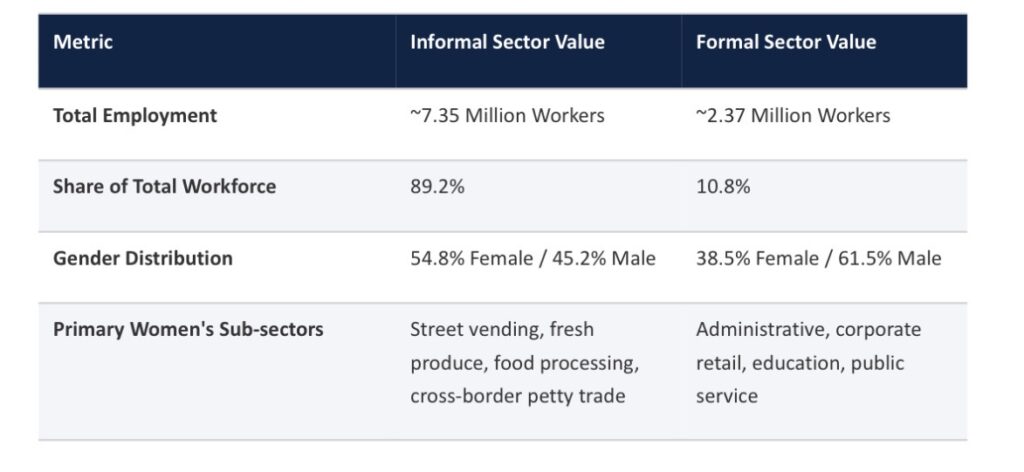
Women are disproportionately represented in the informal sector because it provides the temporal and
spatial flexibility required to balance unpaid care work with income generation. Revenue generated from
these micro-enterprises directly funds non-discretionary household expenditures such as nutrition,
school fees, and healthcare.
C. Data Gaps and Triangulation Strategy
The current policy design is limited by a lack of granular, longitudinal data tracking the precise financial
trajectories of informal traders’ post-displacement. To build a defensible, evidence-based regulatory
framework, the Ministry of Local Government must bridge these gaps through a coordinated data
triangulation architecture using national datasets, operational metrics (KCCA logs), and targeted primary
field data.
Proposed Action: Execute a 3-month rapid evidence assessment in targeted pilot zones (Kampala,
Entebbe, Jinja) using mixed methods to capture sex-disaggregated daily earnings metrics, eviction
frequencies, asset loss values, and subsequent household welfare changes.
- Key Findings and Policy Analysis
3.1 Disproportionate Income Deprivation via Relocation
For informal traders, business viability depends heavily on consumer foot traffic’s convenient routes.
Punitive clearance operations that abruptly relocate street vendors to peripheral or poorly integrated
municipal markets typically result in a 50% to 80% reduction in daily gross revenues. Because women
operate with minimal cash reserves and lack access to formal lines of credit, they cannot absorb these
prolonged income deficits, which often leads to the liquidation of their core working capital.
3.2 Spatial Realities of the Care Economy
Women face distinct structural constraints that dictate their commercial geographies. A centralized
municipal market stall, while legally compliant, often fails to accommodate caregivers who require
spatial proximity to transport hubs or residential areas to manage childcare and domestic obligations.
Forcing women into rigid, inflexible spatial frameworks without accounting for these care dependencies
causes many to drop out of active economic participation entirely.
3.3 The Failure of Enforcement-Only Regimes
Informality is fundamentally a structural response to institutional barriers, including high costs of
regulatory compliance, complex licensing processes, and a shortage of affordable commercial space.
Purely punitive enforcement does not eliminate the structural drivers of informality; it merely displaces
vulnerable economic actors, leading to cyclical re-entry into public spaces, increased evasion costs, and a
breakdown of trust between citizens and local governance institutions. - Re-Framing Policy Objectives and Measurable Outcomes
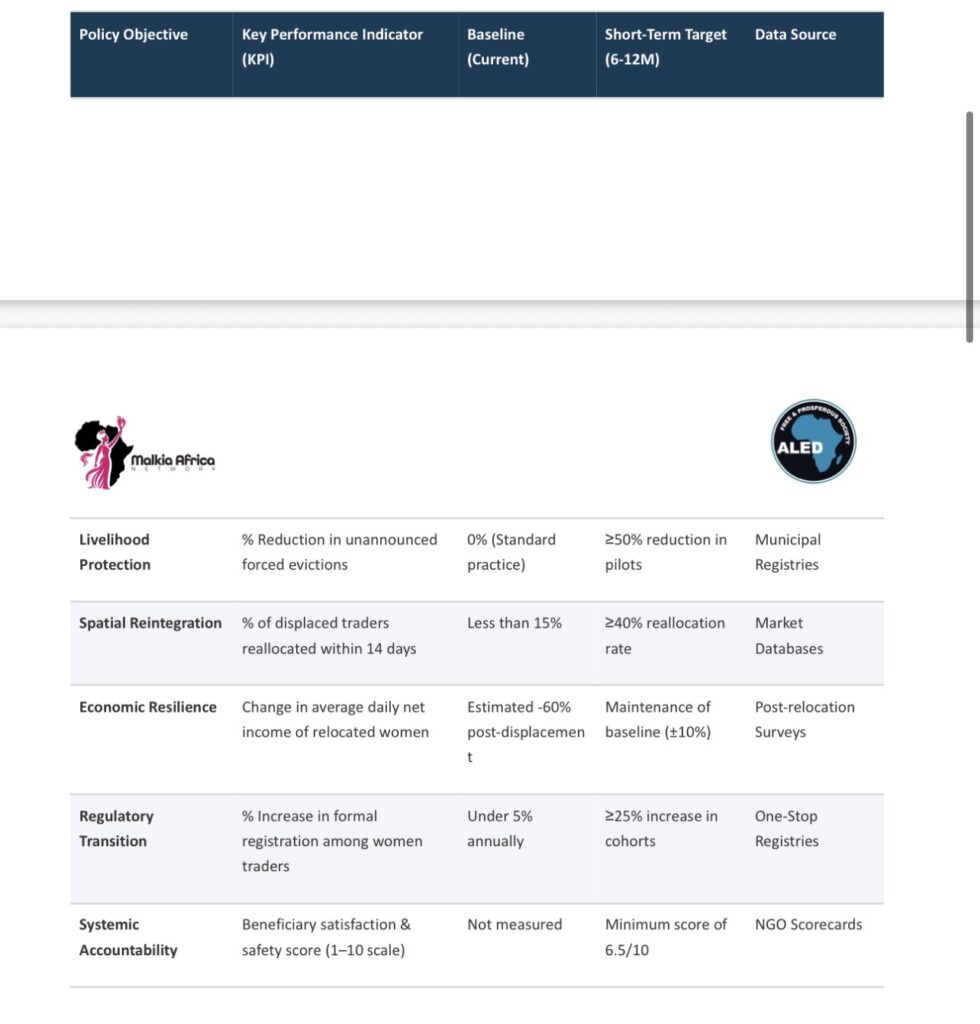
Urban order and women’s economic survival should not be pursued as mutually exclusive goals. Policy
interventions must be designed to satisfy three concurrent objectives: (i) Maintain Urban Order & Public
Safety; (ii) Protect Women’s Livelihoods & Agency; and (iii) Increase Voluntary Formalization
- Operationalizing Recommendations
5.1 Institutionalizing Gender-Responsive Enforcement
● Mandatory Impact Screening: Local government authorities must complete a sex-disaggregated
Socio-Economic Impact Assessment before executing any large-scale trade order normalization
campaign in a commercial zone.
● Vulnerability Frameworks: Statutory administrative codes must be amended to establish explicit
non-eviction protections and alternative, extended relocation timelines for highly vulnerable groups,
including pregnant women, single primary caregivers, and elderly traders.
5.2 Expanding Strategic, Low-Cost Trading Spaces
● Modular Infrastructure Deployment: Municipal engineering departments must map underutilized
public land and transit corridors to install low-cost, secure, and weatherproof modular trading kiosks.
The pilot phase requires the deployment of 200 units per target city.
● Tiered Pro-Poor Fee Structures: Local government financial frameworks must replace flat market
levies with a progressive, tiered fee system. Ultra-poor women vendors and street-level transitions will receive a 100% fee exemption for the first 6 months, followed by a graduated, subsidized rate scale tied to verified revenues.
5.3 Establishing Inclusive Engagement and Notice Protocols
● Mandated Representation: Municipalities must legally restructure Market Management Committees
to include formal, elected informal-trader representatives, with an explicit statutory requirement
that at least 40% of these representatives are women.
● Statutory Notice Requirements: All planned trade order updates must be preceded by a mandatory
90-day formal consultation window accompanied by local public notices broadcast in relevant local
languages via radio and market public address systems.
5.4 Designing Incentive-Based Formalization Paths
● The ‘Starter License’ Framework: Local authorities will introduce an integrated, single-window
“Starter License” for informal micro-enterprises. This registration features a nominal entry fee, is
valid for 12 months, and automatically includes a Business Support Voucher that grants access to
financial literacy training, micro-credit matching programs, and government-backed savings
schemes.
● Decentralized Mobile Registration: To eliminate administrative friction, municipalities will deploy
Mobile Registration Units directly into informal market spaces, reducing the time required to
formalize to under 15 minutes.
5.5 Legal Literacy and Municipal Aid Clinics
● Rights Awareness Campaigns: Partner with civil society organizations to launch targeted
local-language information campaigns clarifying market bye-laws, tax structures, and traders’ rights.
● Legal Aid Infrastructure: Establish weekly Municipal Legal Aid Clinics within public markets to help
women traders navigate business registration, resolve lease disputes, and report administrative
harassment or extortion.
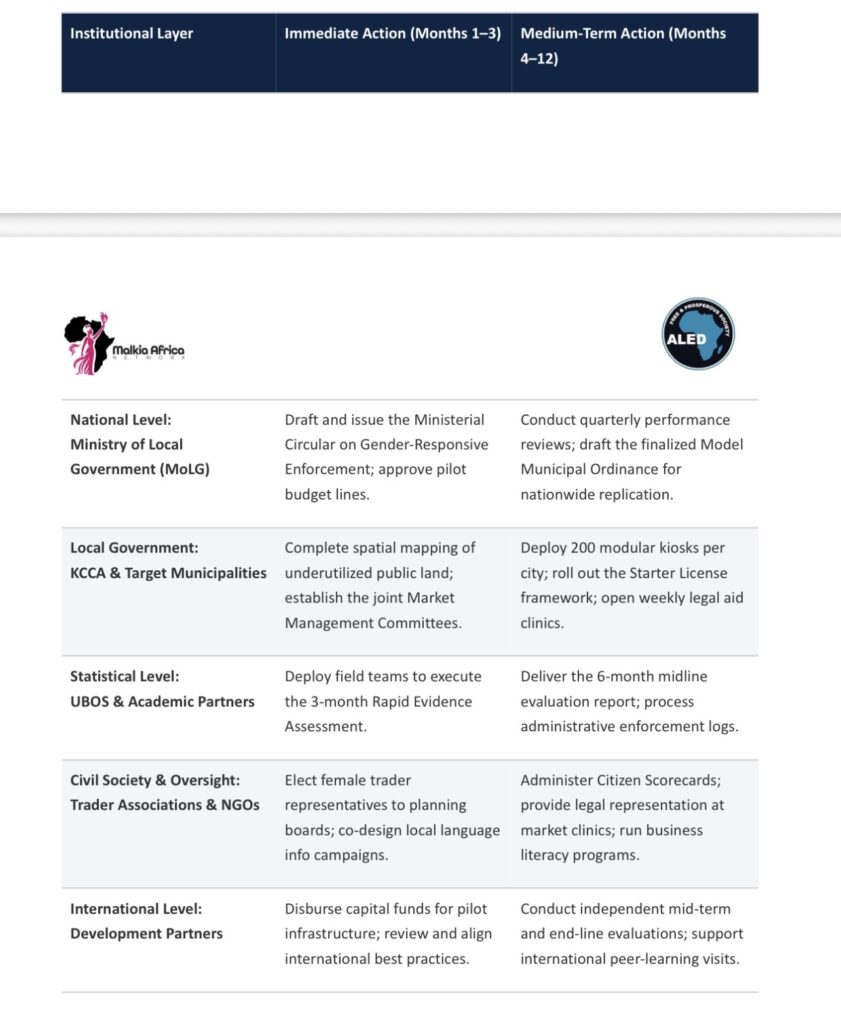
- Implementation Architecture and Institutional Roles
Successful execution requires an integrated approach across multiple layers of governance. The matrix
below defines the division of labour and operational timelines for each stakeholder:
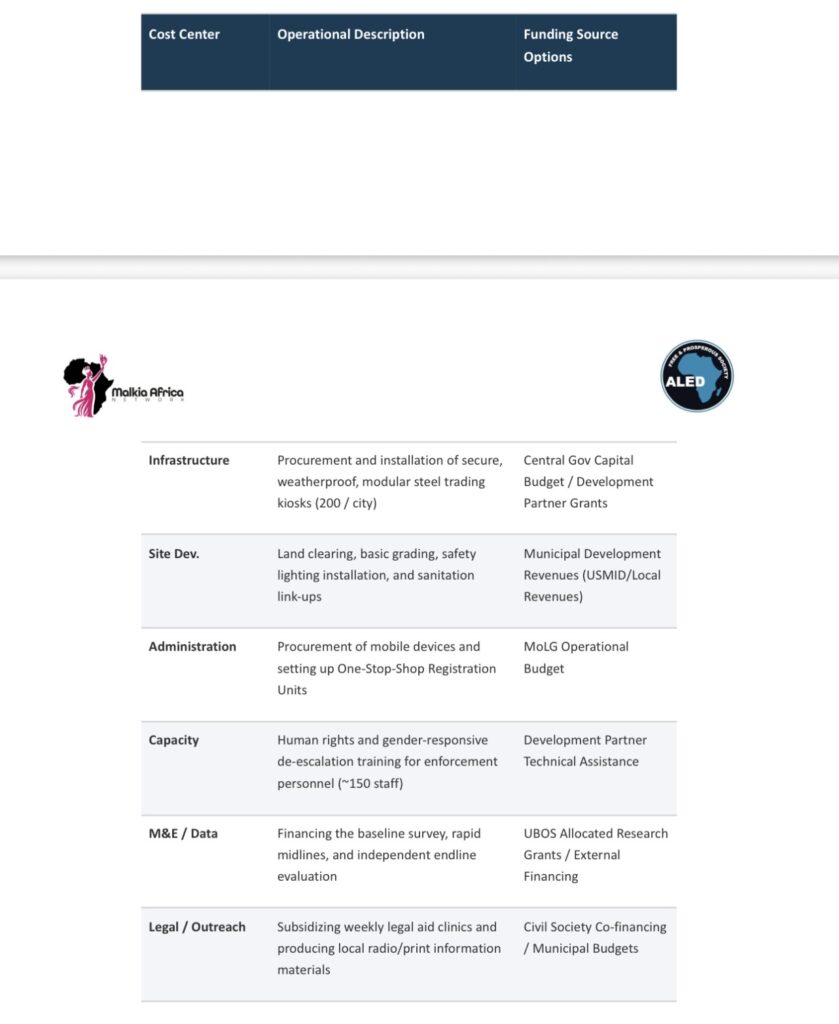
- Budgeting and Financing Model
The operationalization of this framework requires shifting municipal resources from reactive policing to
proactive infrastructure investment. The table below outlines the estimated budget requirements for a
single urban center pilot:
Sustainable Revenue Generation Model: To ensure fiscal sustainability beyond the initial pilot phase, the
program will transition into a self-sustaining revenue loop via graduated kiosk fees (collected after the
initial 6-month exemption), starter license fees that provide predictable municipal revenue collections,
and public-private partnerships (PPPs) allowing financial institutions to purchase advertising space or
co-finance infrastructure.
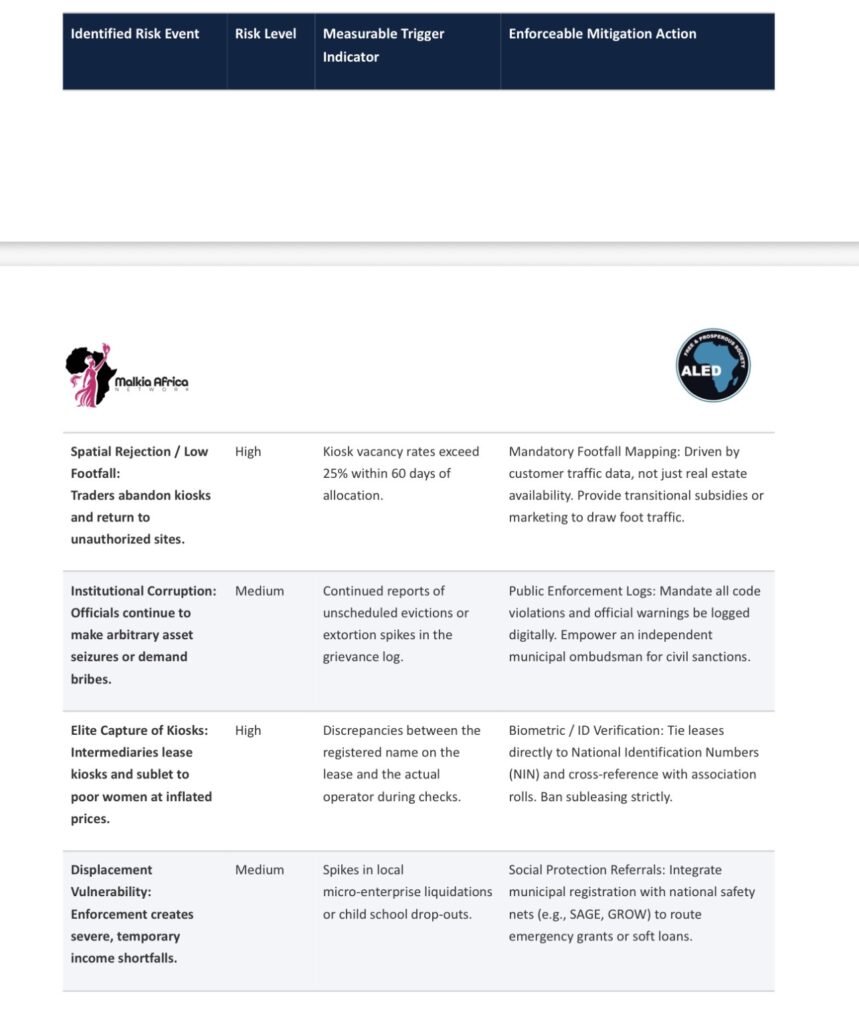
8. Risk Assessment and Mitigation Framework
- Monitoring, Evaluation, and Learning (MEL)
To support evidence-based scale-up decisions, the pilot program will follow a strict, independent
evaluation cycle: (1) Baseline Evaluation within 60 days of launch; (2) Quarterly KPI Dashboard Reporting
submitted by municipal enforcement offices; (3) Midline Review at Month 6 to adjust location
placements or subsidies; and (4) Independent Endline Evaluation at Months 12–18 to assess
performance against final Scale-Up Decision Criteria. - Legal and Regulatory Adjustments
Implementing these recommendations requires updating existing local by-laws and national frameworks
to provide clear legal backing for transitional arrangements. This includes reviewing municipal bye-laws
to permit temporary, multi-use trading zones, issuing a Ministerial Circular on Gender Impact Assessments, and fast-tracking a Model Municipal Ordinance for local councils to legitimize arragements.
- Communication and Stakeholder Buy-In
A Local Stakeholder Compact will be signed between municipalities, trader associations, and civil society
groups before launch to ensure joint commitment. This will be accompanied by a comprehensive public
communications strategy emphasizing the dual goals of urban management: supporting local livelihoods
while organizing public spaces. - Equity and Inclusion Specifics
To ensure the program reaches those who face the steepest economic barriers, all interventions will
follow strict equity priorities, targeting ultra-poor women, single mothers, and elderly vendors via
community-vetted registers. Additionally, municipal market engineering must prioritize inclusive design
features, such as sanitary facilities, safety lighting, and child-care considerations. - Scale-Up Decision Criteria
The transition from a pilot program to a national framework will depend on achieving specific
performance benchmarks during the evaluation cycle: (i) reduced evictions by ≥40% vs baseline metrics;
(ii) maintained or increased average income for relocated women; and (iii) achieved ≥25% voluntary
formalization among pilot participants. If these are met alongside positive beneficiary satisfaction
metrics (≥6.5/10), a phased national rollout will follow. - Conclusion and Immediate Actions (First 90 Days)
Trade order enforcement serves important public policy objectives, but its execution must recognize the structural realities of Uganda’s workforce, where informal trade is a vital economic lifeline for women. Transitioning from punitive displacement to an inclusive, incentive-driven integration framework allows Uganda to build more orderly, resilient, and equitable cities.
Immediate Action Plan (First 90 Days):
- Days 1–30 (Issue National Policy Guidance): The Ministry of Local Government issues a binding
Ministerial Circular mandating that all local government authorities incorporate socio-economic and
gender impact screenings into their urban trade management plans
- Days 31–60 (Commission the Rapid Assessment): Authorize and fund UBOS, in partnership with
local municipal councils, to launch a 3-month rapid field assessment to collect sex-disaggregated
baseline data in Kampala, Entebbe, and Jinja. - Days 61–90 (Approve the Pilot Budget Allocations): Review and approve the 12-month pilot budget
request to secure the procurement of modular kiosks, deploy mobile registration units, and establish
oversight structures in the target cities.
Annex: KPI Definitions and Budget Assumptions
Forced Eviction: Any spatial clearance or removal of informal traders from a public trading site by
municipal authorities conducted without a prior 90-day notice period or an official alternative relocation
option.
Starter License: A temporary micro-business registration pathway that waives standard corporate
compliance requirements, designed to provide informal traders with an accessible transition into the
formal municipal regulatory framework.
Core Budgetary and Costing Assumptions: Kiosk costs are calculated based on locally fabricated, durable,
and weather-resistant steel frame structures measuring approximately 2m x 2m. Personnel training costs
assume a standard 3-day curriculum focused on gender-responsive de-escalation strategies. Revenue
projections assume a conservative 85% long-term occupancy and fee collection rate across deployed
kiosk clusters following the expiration of the initial 6-month pro-poor subsidy window.
References:
Gumisiriza, P. (2020). Street vending in Kampala: From corruption to crisis. African Studies Quarterly,
20(1), 73–94. https://asq.africa.ufl.edu/wp-content/uploads/sites/168/V20i1a5.pdf
Guloba, M. (2019). Rural women entrepreneurship in Uganda: A synthesis report on policies, evidence,
and stakeholders. Economic Policy Research Centre (EPRC). INCLUDE Knowledge Platform.
https://includeplatform.net/wp-content/uploads/2019/07/RURAL-WOMEN-ENTREPRENEURSHIP-IN-UG
ANDA-1.pdf
International Monetary Fund. (2005). Uganda: Poverty reduction strategy paper. IMF Staff Country
Reports, 05(141), 1–280. https://doi.org/10.5089/9781451838770.002
Lindell, I., Ampaire, C., & Byerley, A. (2019). Governing urban informality: Re-working spaces and
subjects in Kampala, Uganda. International Development Planning Review, 41(1), 63–84.
https://doi.org/10.3828/idpr.2019.4
Nakibuuka, M. (2015). The vulnerable livelihoods of street vendors in Uganda: A case of Kampala Central
Division (Master’s thesis). Erasmus University Rotterdam: International Institute of Social Studies.
https://thesis.eur.nl/pub/32987/MNakibuuka_MA_2014_15_SPD.pdf
Vieitez-Cerdeño, S., Manzanera-Ruiz, R., & Namasembe, O. M. M. M. (2023). Ugandan women’s
approaches to doing business and becoming entrepreneurs. Third World Quarterly, 44(7), 1435–1454.
https://doi.org/10.1080/01436597.2023.2189580
Prepared by: Daphne Naudho (Action for Liberty and Economic Development) & Joyce Mary Takali (Malkia Africa Network)