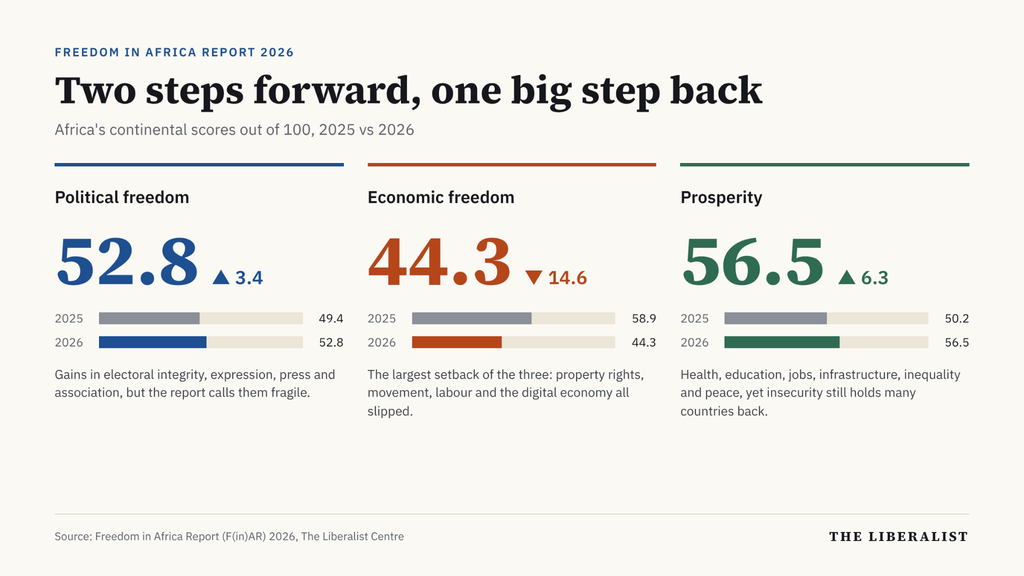
Africa has recorded improvements in political freedom and prosperity, but economic freedom has declined significantly, according to the 2026 Freedom in Africa Report (F[in]AR).
The report, which assesses freedom and living conditions across African countries, found that the continent’s political freedom score increased from 49.4 in 2025 to 52.8 in 2026. Prosperity also improved, rising from 50.2 to 56.5. However, economic freedom recorded a drastic decline, falling from 58.9 to 44.3 over the same period. The figures show that progress in political rights and living standards has not necessarily translated into better economic conditions for people across the continent.
Launched on October 31st at the Conference of Freedom Advocates (CFA), F(in)AR 2026 is the second edition of the Liberalist Centre’s annual assessment of freedom and prosperity in Africa. It examines three areas: political freedom, economic freedom and prosperity.
The report relies on existing data from international and African organisations such World Bank, Africa Visa Openness Index (AfDB/AU) and International Labour Organisation (ILO). It uses the most recent available figures, mainly from 2026, and 2025 data where newer figures were unavailable. The indicators are combined to produce scores that allow comparisons between countries.
Political Freedom
The report found an improvement in Africa’s political freedom score, with progress recorded in areas such as electoral integrity, freedom of expression, press freedom, freedom of association and institutional protections.
Some countries recorded notable improvements. For instance, Ghana’s electoral integrity score rose from 6.8 to 9.5, while Morocco’s increased from 2.9 to 7.9. Côte d’Ivoire also recorded an improvement, rising from 1.8 to 6.0. However, the report warned that the progress has not been experienced across the continent. Countries such as Chad, Burundi, Cameroon, Egypt and Equatorial Guinea recorded setbacks in different areas of political freedom.
It also highlighted continuing concerns about judicial independence, electoral manipulation and restrictions on citizens’ rights. Although the overall score improved, the report said the gains remain fragile. According to Afrobarometer, a pan-African research network that conducts public attitude surveys on democracy, governance and economy, 65 percent of citizens surveyed across 38 African countries feel at least somewhat free to express their opinions. However, the report noted that this figure has now declined by 7 percent.
The Decline
While political freedom improved, economic freedom recorded the largest setback among the three areas assessed. The score fell from 58.9 in 2025 to 44.3 in 2026, despite improvements in some areas, including business conditions, labour freedom and digital economic activity.
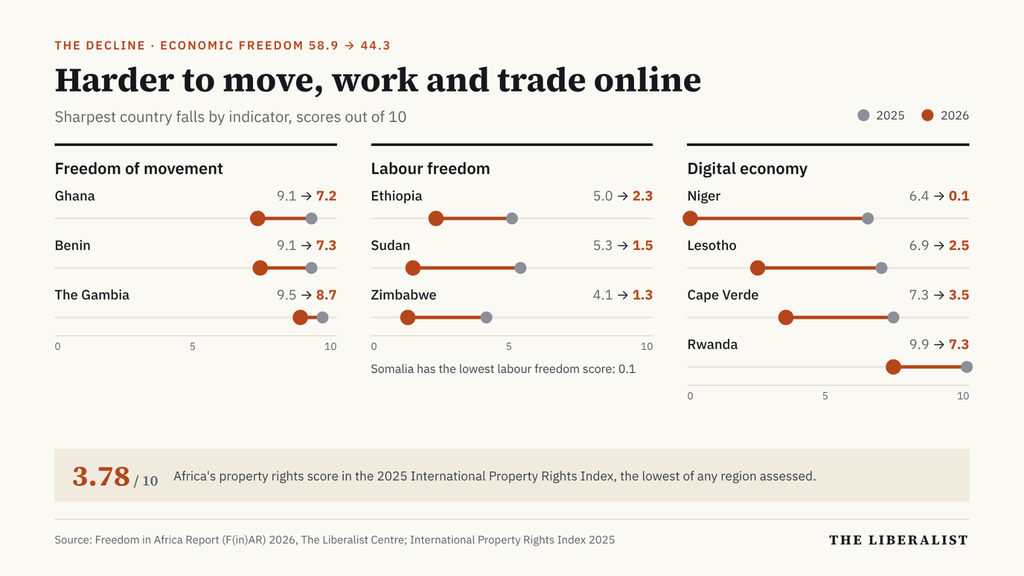
F(in)AR attributed several factors that affect people’s ability to work, own property, start businesses and participate in the economy. These include property rights, the cost of starting a business, trade restrictions, taxation and access to digital services. Property rights remain one of the areas where many African countries face difficulties. In the 2025 International Property Rights Index, Africa recorded a property rights score of 3.78 out of 10, the lowest among the regions assessed.
Declines were also recorded across freedom of movement, labour freedom and the digital economy, although the affected countries differed. In freedom of movement, Ghana’s score fell from 9.1 to 7.2, while Benin dropped from 9.1 to 7.3 and The Gambia from 9.5 to 8.7. Labour freedom also weakened in Ethiopia, Sudan and Zimbabwe, whose scores fell from 5.0 to 2.3, 5.3 to 1.5 and 4.1 to 1.3 respectively. Somalia recorded the lowest score at 0.1. In the digital economy, Niger experienced the sharpest decline, falling from 6.4 to 0.1. Lesotho’s score dropped from 6.9 to 2.5, Cape Verde’s from 7.3 to 3.5, and Rwanda’s from 9.9 to 7.3.
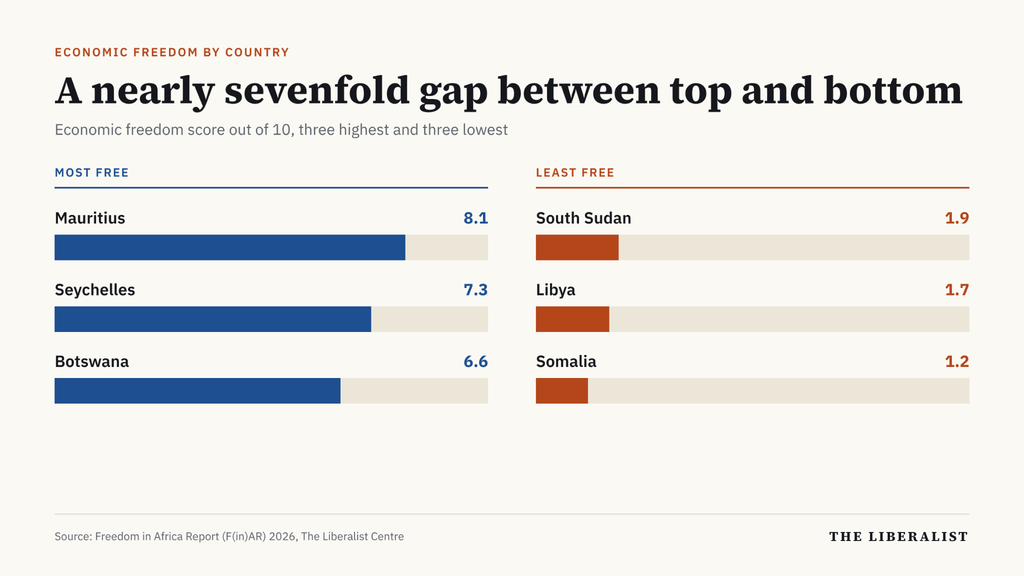
The differences are also reflected in the overall economic freedom scores of African countries. Mauritius ranked highest with 8.1, followed by Seychelles at 7.3 and Botswana at 6.6. Somalia recorded the lowest score at 1.2, while Libya and South Sudan scored 1.7 and 1.9 respectively.
While economic freedom declined, Africa’s overall prosperity score improved from 50.2 in 2025 to 56.5 in 2026. The assessment considers factors beyond income, including access to healthcare and education, employment, infrastructure, economic inequality, and peace and stability. However, the improvement does not mean that the continent’s challenges have been resolved. Insecurity, inequality, limited employment opportunities and poor access to essential services continue to affect living conditions. Countries affected by conflict often struggle to improve prosperity as instability disrupts economic activities and limits access to services and opportunities.
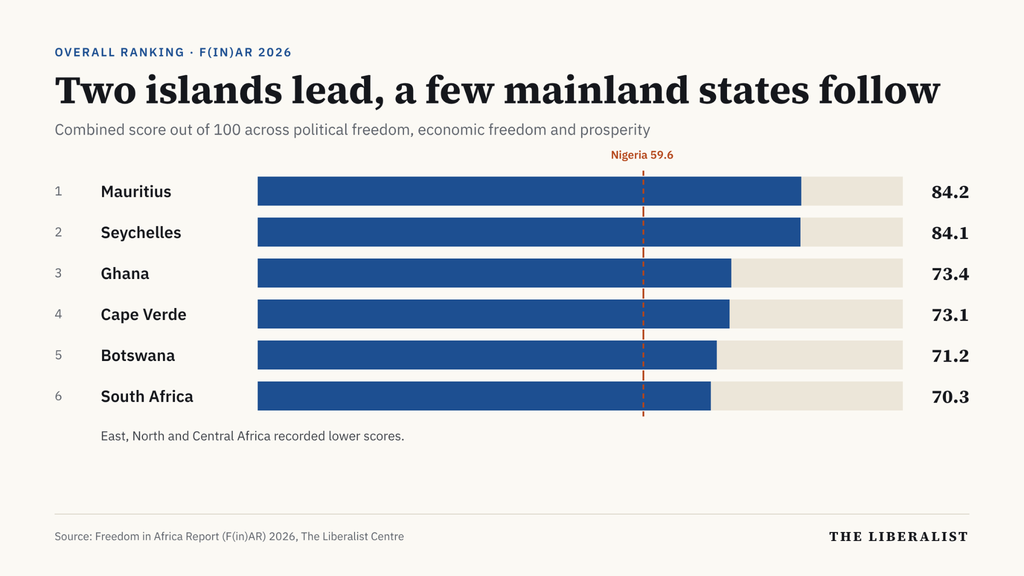
The country rankings show considerable differences in freedom and prosperity across Africa. Mauritius recorded the highest overall score at 84.2, followed by Seychelles at 84.1. Ghana came third with 73.4, followed by Cape Verde at 73.1, Botswana at 71.2 and South Africa at 70.3, which recorded the strongest regional performance. East Africa, North Africa and Central Africa recorded lower scores.
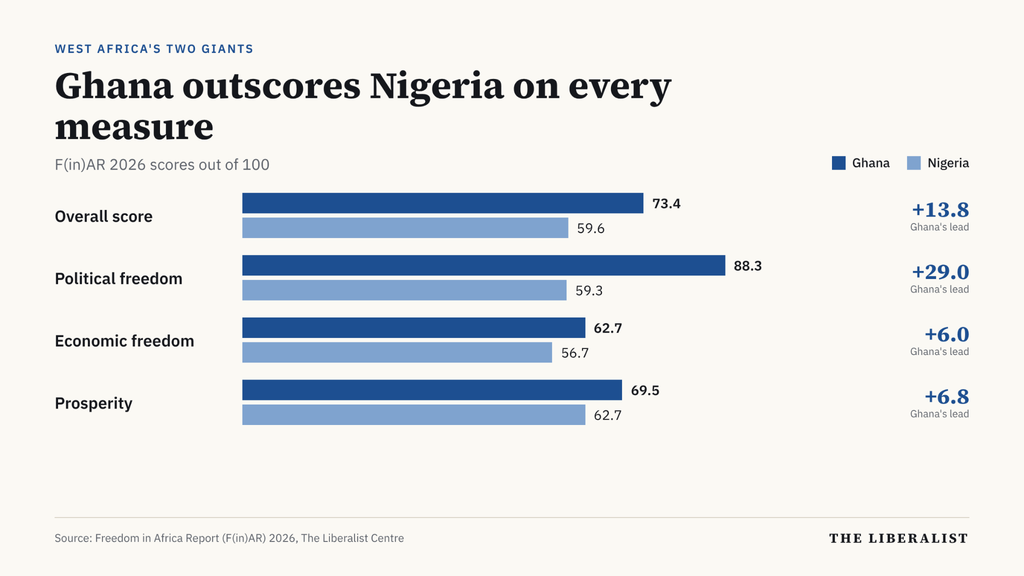
In West Africa, Ghana performed better than Nigeria across the three areas assessed. Ghana recorded an overall score of 73.4, compared to Nigeria’s 59.6. Ghana scored 88.3 in political freedom, 62.7 in economic freedom, and 69.5 in prosperity. In contrast, Nigeria recorded 59.3 in political freedom, 56.7 in economic freedom, and 62.7 in prosperity.
Beyond the three main areas, the report examined the state of cross-border movement and digital access in Africa. It found that only 28 percent of travel routes between African countries allow visa-free movement, while 25 percent offer visas on arrival. The remaining 47 percent require travellers to obtain visas before departure.
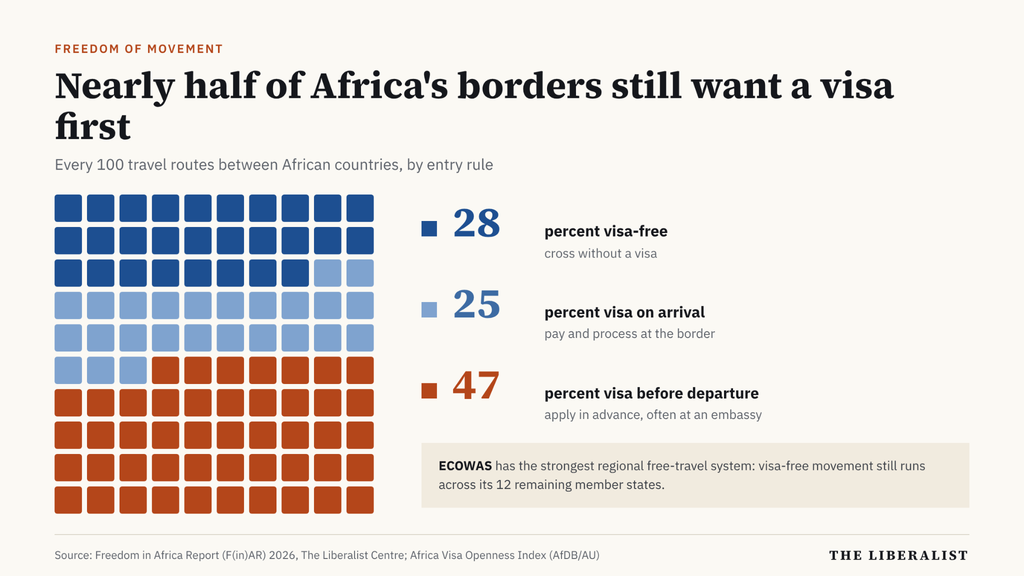
The Economic Community of West African States (ECOWAS) was identified as having the strongest regional free-travel system, with visa-free movement still operating among its 12 remaining member countries. The report also highlighted the economic importance of digital access. It stated that mobile technology contributed $240 billion, representing 7.8 percent of Africa’s gross domestic product, and supported 13 million jobs. However, it found that 63 percent of the population remains outside mobile internet use because smartphones and data are unaffordable for many people. It also cited 30 internet shutdowns across 15 African countries, which affected online businesses, mobile payments and civic participation.
The report further discussed the growing role of young Africans in public life, noting that many are using protests, social media and community organising to challenge corruption and demand accountability. However, it raised concerns about restrictions on protests and the detention of demonstrators in several countries.
F(in)AR 2026 signals that while improvements in political freedom and prosperity offer some signs of progress, the decline in economic freedom shows that many people and businesses still face difficulties in accessing opportunities. It argues that progress requires more than improvements in individual areas. Stronger institutions, protection of individual rights, better business conditions and wider access to essential services are all important in ensuring that freedom translates into better opportunities and living conditions for Africans.